How to Use AI Video Translator for Multiple Languages
Contents
Introduction
With more than 20 languages available (eg. English, Spanish, French, Japanese, Portuguese, etc.), The AI Video Translator instantly translates your video into those languages. The AI technology creates a unique look and feel for each language and allows you to upload your content once and get back a finished/translated product that will appeal to 95% of people online. Whether you want to translate Social Media Content, Commercials, or Product Stories - The AI Video Translator enables a global connection without requiring any knowledge or experience of professional translations.
Why You Definitely Need an AI Video Translator for Your Content
The world is vast. If you limit yourself to your own linguistic bubble, you’ll be greatly constrained. With an AI translator, you can translate your products or videos into a wide range of languages.Translation of videos has traditionally required a lot of effort and expense if done via traditional means. If you want your video translated manually, you will need to engage the services of a professional translator. You will need to pay them for their time and effort, and you will spend a lot of time sending translations back to each other to correct mistakes/errors. In addition, you will also have to create subtitles and dub your video line by line. All of this time and expense can make the process of translating videos via traditional means not worth the hassle.
Now, however, we live in the age of technology, maybe you have used chatgpt/Gemini/Gork etc.AI-powered video translators tool that can perform the task of translating video effortlessly. With the push of a button, an AI video translator can create voiceovers of the audio and automatically generate subtitles for the audio with lip-syncing capability. This means that you can use AI video translators to provide video translation services to people around the world with little effort or expense on your part.
What is AI Video Translation and How Does It Work?
What is AI Video Translation?
AI video translation uses AI to convert videos from one language to another.If you used ai tools you must be konw, It automates transcription, translation, subtitling, and dubbing—saving creators, businesses, and educators days or weeks of manual work.
The goal is very simple,you can use ai video translator tool to achieve upload a video, let AI process the audio and visuals, and get natural-sounding versions in other languages. Tools create realistic voiceovers (with voice cloning), preserve tone and emotion, and even sync lip movements for more believable results.
How Does AI Video Translation Work?
The process runs automatically in minutes (depending on length):
- Speech Recognition (ASR) AI transcribes the audio into timed text, auto-detects the source language, and handles accents/noise well with current models.
- Text Translation (NMT) Neural engines translate the transcript into the target language, keeping context, idioms, tone, and natural phrasing intact.
- Subtitle Generation Translated text becomes synced on-screen subtitles. Customize style, position, or burn them permanently into the video.
- Voiceover & Dubbing AI generates dubbed audio using TTS, cloned voices, or expressive models. Advanced tools add lip-sync by matching mouth movements to the new audio.
Finally You up will get a fully localized video (subtitles, dubbing, or both) ,you can up to YouTube, TikTok, or any platform— compare with traditional ways,its much faster and cheaper. And,quality is excellent for clear speech; for slang-heavy or emotional content, a quick human check makes it perfect.
How to Translate Your Videos Using AI Video Translator
Here's a simple, step-by-step guide to using an AI Video Translator:
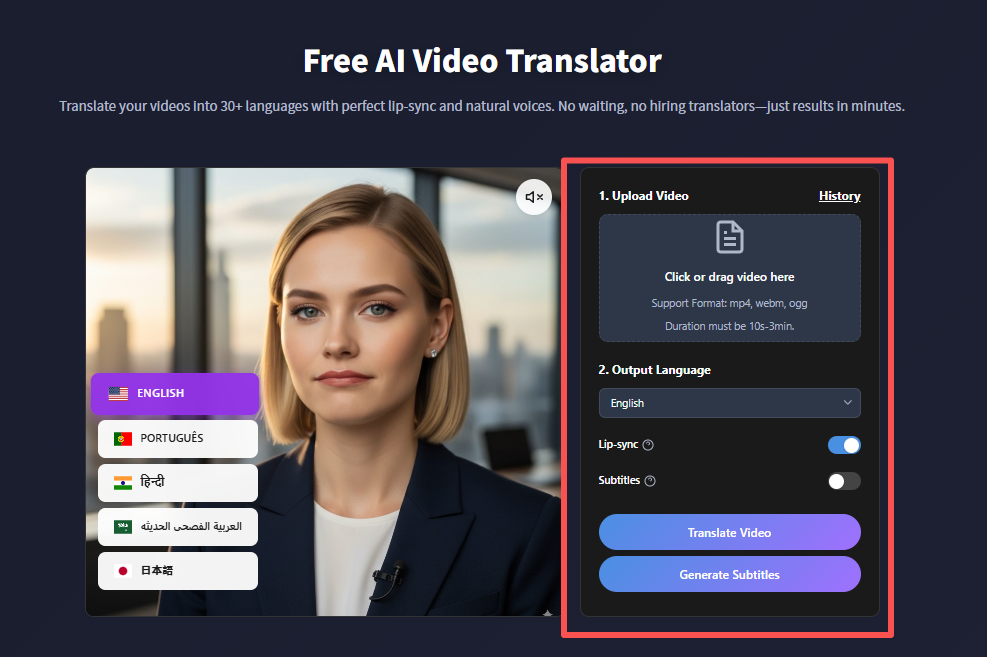
Step1-Upload Your Video
Go to the platform's dashboard and click "Upload" or "New Project."Drag and drop your file (MP4, MOV, AVI, WebM, etc.) from your computer,The tool will quickly analyze the audio and visuals—usually ready in seconds to a minute.
Step2-Select Your Target Language
Choose the language(s) you want to translate your video into. There are more Popular options you can choose include Spanish, French, German, Chinese, and many more.
Step3-Enable Lip-Sync
Turning this on tells the AI to adjust the speaker’s mouth movements in the video to better match the new translated audio.This feature dramatically improves realism, especially for talking-head videos, interviews, or educational content.
Step4-Choose Subtitles (On-Screen or Burned-In)
When you choose to enable subtitles, your video will automatically generate subtitles in the language you selected. You can opt for on-screen subtitles, which can be turned on or off by the viewer, or burned-in subtitles, which are permanently embedded in the video for easy viewing without any adjustments.
Step5-Export the Translated Video
After you are satisfied with the translations, export the video in the desired format.This process turns one video into global content with minimal effort, saving time and money compared to traditional localization.
Use Cases of AI Video Translation
AI video translation is a versatile tool with a wide range of applications. It is perfect for content creators, marketers, and educators. Here are some examples of how different user groups can benefit from it:
Content Creators
If you're a content creator, those ideas and stories you're most proud of? They deserve to reach the whole world. Right now, with AI translation tools, you can turn your YouTube long-form videos, TikTok clips, Instagram Reels, or those little image+text notes on Xiaohongshu/Weibo into Korean, Japanese, Spanish, Arabic… whatever language you want, in just a few minutes.Whether you're filming travel vlogs, coding tutorials, outfit & skincare hauls, or creepy storytelling—once you start speaking directly in their native language, the audience reaction completely changes. They don't just "understand" anymore; they feel like, "Whoa, this person is actually talking to me."
My creator friends who've done this pretty much all say the same thing: stick to translating your main stuff into just 2–3 big languages, and your overseas views at minimum double, sometimes straight-up explode. Your fanbase goes from one-country-only to a mini United Nations. People start making fan edits for you, commenting at 3 a.m. their time, or straight-up sharing your video in their local forums and group chats.
Marketers
For marketers, translating promo videos, product demos, brand stories, and social ads into local languages is a real game-changer. if you nail the tone and vibe in their native language, audiences instantly feel like “this brand gets me.”and It helps convey the brand's values and philosophy.
Look at today's hotspots: Southeast Asia's ecommerce is booming (GMV projected around $185–230 billion in 2025), Europe's luxury shoppers are picky as hell, and Latin America's digital growth is accelerating fast. Localized content is what helps you actually stand out in all that ad noise.
From real tests we've seen: adapt short ads to local platforms and language, and conversions often rise 20–50%; add good subtitles or dubbing to explainers, and trust builds quickly—driving more repeats and shares.
AI tools make this fast and affordable now, but always run a native check on tone, idioms, and cultural references. Skip that step, and you risk awkward flops.
Educational Institutions
Educational institutions,Turn recorded lectures, online courses, and MOOC videos into multiple languages fast — so international and remote students can Barrier-free understanding.The same goes for cutting-edge AI or biomedical research lectures: once translated into multiple languages and uploaded to the institution’s website or ResearchGate, graduate students and professors who aren’t native English speakers can sound totally native and genuine. For K-12 schools or university education departments, think about those flipped classroom training videos for teachers. Use AI to translate them into the languages spoken by educators across different regions, with voices that sound authentic and local. Education quality will inproves step by step.
Why AI Video Translation is a Game-Changer
In a world where video content dominates online attention, language barriers used to limit who could actually watch and understand your work. AI video translation changes that completely. It turns a single video into versions that feel native to speakers of dozens of languages—often in minutes instead of weeks.
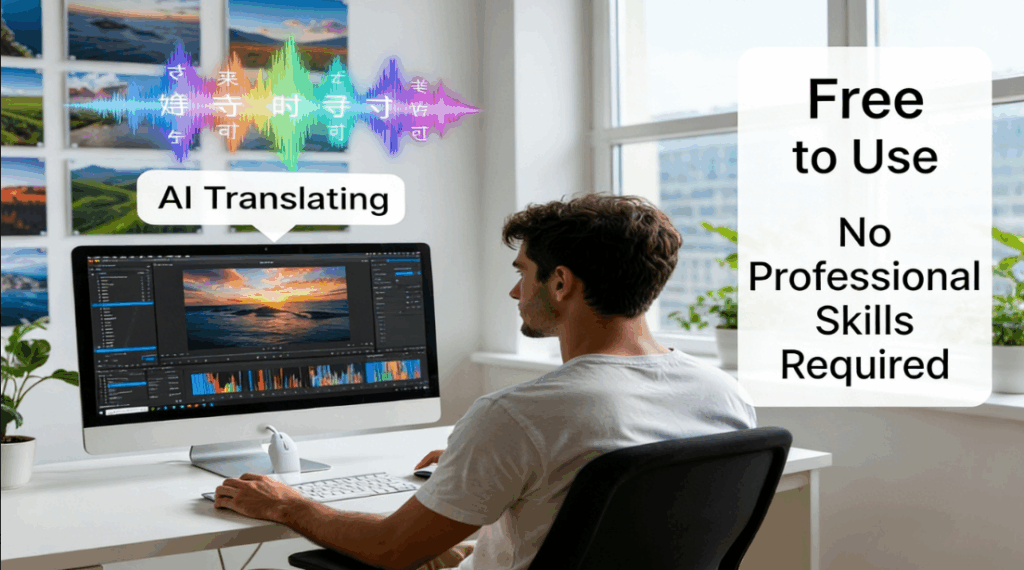
Here are the biggest real-world advantages creators, marketers, and businesses are seeing right now:
Massive Time Savings
Past, used to take professional translators, voice actors, subtitle editors, and post-production teams days or even weeks,But now, you can cut the time by at least half with an AI video translation tool. Just upload once, choose your languages, and spend your energy on scripting, filming, or promoting instead of localization logistics.
Much Wider Reach & Engagement
A video that’s only in English might top out at a few hundred thousand views. Add Spanish, Portuguese, Hindi, Arabic, or Indonesian versions, and suddenly you’re tapping into billions more potential viewers. Many creators report 2–5× higher watch time and subscriber growth after going multilingual.
Dramatically Lower Costs
Hiring human translators, dubbing artists, and editors for multiple languages easily runs into thousands of dollars per video. Modern AI tools often cost a fraction of that—sometimes just a few dollars per minute of video—while delivering quality that’s good enough for most purposes (and getting better every month).
Improved Consistency & Fewer Mistakes
Humans can mishear words, mistranslate idioms, or lose tone across long projects. AI applies the same high-quality neural translation models consistently throughout the entire video, catching context better than ever before. Plus, built-in previews let you spot and fix any edge cases quickly.
Bottom line: AI video translation isn’t just a nice-to-have anymore—it’s one of the fastest ways to scale your audience globally without scaling your budget or workload.Click the image below for a fast trial of the AI Video Translator.
Frequently Asked Questions
How accurate is AI video translation today?
For everyday topics and widely spoken languages (English ↔ Spanish, French, German, Chinese, etc.), accuracy is very high—often 90–98% on clear audio. It handles context, slang, and tone much better than a few years ago. That said, for highly technical content, heavy accents, overlapping speech, or cultural nuances, a quick human review still makes a noticeable difference.
What video formats and languages does the AI Video Translator support?
We handle common formats like MP4, MOV, and WEBM, with a 500MB max file size (up from 30MB last year). Languages? Over 30, including English, Spanish, Mandarin, Arabic, and more. If you need a niche one, let us know; we can often add it.
Does it support lip-sync for dubbed videos?
Many leading tools now offer realistic lip-sync (mouth movement adjustment) for talking-head or interview-style videos. Results vary depending on the original footage and tool, but on front-facing shots with good lighting, it often looks surprisingly natural in 2026.
How long does it take for the AI Video Translator to process a video?
Processing time depends on video length: a 1-minute video takes 2-3 minutes for our AI Video Translator to complete.
Is the translated content good enough for professional or monetized use?
Absolutely for YouTube, TikTok, or marketing—creators report 20-40% more views after localizing with AI (e.g., MIT's OpenCourseWare saw 40% boost in non-English regions). For legal/medical, pair it with pro editing to hit 99% accuracy. It's a game-changer, but not fully hands-off yet.